Thursday, December 11, 2014

Muscle System Blog

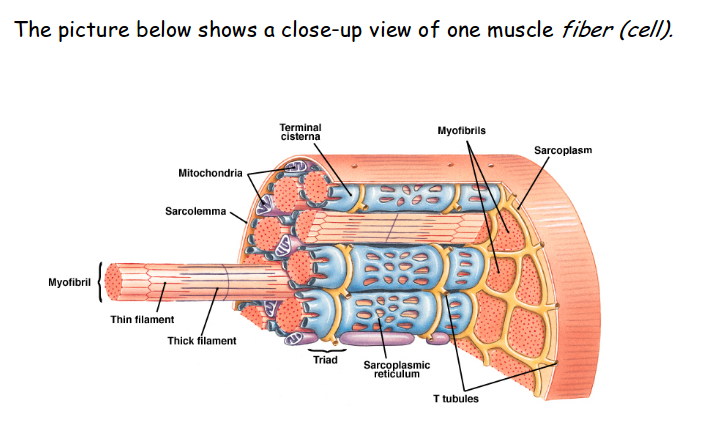
Bones have attachments of tendons which is attached to the epimysium, and it seperates the muscle from surrounding tissue. Inside the epimysium is the perimysium which divides the muscle into compartments called fascicles. In depth of the perimysium is the endomysium, and that seperates each fiber and ties closer fibers together. Inside the endomysium are muscle fibers, they contain organelles and tightly packed myofibrils. Myofibrils make up 80% of cellular volume and they contain myofilaments which have I-band (thin filament: Actin- Z line) and A-band (thick filament: Myosin- M line). Inside the muscle fibers is the sarcolemma and it is a muscle cytoplasm with glycosomes and myoglobin, and inside that is the sarcoplasmic reticulum and that modifies and elaborates smooth endoplasmic reticulum which stores calcium ions and releases on demand. T-tubules are continuations of sarcolemma that penetrate into cell. The mitochondria is between the myofibrils and it produces energy.


The muscles contract and contain energy by the sodium potassium pump (Na+ K+ Pump). At the neuromuscular junction ACh is released by synaptic terminal and binds to receptors on sarcolemma. Resulting change in membrane potential leads to production of an action potential that spreads across the entire surface of muscle fiber and along the T-tubules. Sarcoplasmic reticulum releases stored calcium ions, increasing calcium concentration in the sarcoplasm. Calcium ions bind to troponin, resulting in movement of tropomyosin and exposure of active sites on the thin filaments. Crossbridge form when myosin heads bind to active sites. Contraction begins as repeated cycles of crossbrigde binding, pivoting, and detachment occur, powered by the breakdown of ATP. These events produce filament sliding, and muscle fiber shortens. Action potential generation ceases ACh is broken down by AChE. The sarcolplasmic reticulum reabsorbs calcium ions in the sarcoplasm declines. When calcium ion concentration approach normal resting levels, the troponin and tropomyosin molecules return to their normal positions. This recovers the active sites. With the active sites no longer accessible, crossbridge formation cannot occur. Without crossbridge interactions, further sliding cannot take place, and the contraction ends. Muscle relaxtion occurs, and the muscle returns passively to its resting length.


Friday, December 5, 2014

Weekly Three Questions

1. What tasks have you completed recently?
A: I've recently completed a packet about the sodium potassium pump and flipped questions about it.
2. What have you learned recently?
A: I recently learned about the changes of the charges of Na+ and K+, also, that action potential plays a part in it.
3. What are you planning on doing next?
A:  I hope to learn more about how the sodium potassium pump plays a part in the muscular system.

Friday, November 21, 2014

Weekly Three Questions

1. What tasks have you completed recently?
A: I've recently completed a skeletal system test.
2. What have you learned recently?
A: I recently learned about the important muscles of the human body
3. What are you planning on doing next?
A:  I hope to learn more about the ways to strain a muscle.


Tuesday, November 11, 2014

Skeletal System

The integumentary system and the skeletal system are physiologically related by the protection of the framework of the body. The integumentary system protects all the organs of the body and makes sure they are not opened to the outside and the skeletal system keeps hold of the organs in their place and what makes up the structure of the body. The integumentary system is a physical, chemical/biological, and water barrier. For physical barrier it has cells that contain keratin and are attached to each other by desmosomes. Chemical/Biological barrier are acid secretions from glands that retard growth of fungi, microbes, and viruses, which flushes the microbes surface, the melanin stops UV from penetrating to deeper tissues. The water barrier contains carotene and it's an impacting loss and gain. For the skeletal system there are bones that are constantly being renewed to keep hold of the body. Also, in the skeletal system, the way it is made, each organ should have its own space and do the functions that it should. The bones are responsible for growth and repair, and they differ by regions of a bone and of the person. Since the bone is always being restored, it can replace the matrix, leaving the shape of the bone unchanged; it's responsible for changing the shape of the bone; it can change the internal architecture of a bone; and it can change the mineral composition of the bone. Lastly, hematopoiesis is an important part, it is the blood cell formation in red marrow. In adults the red marrow is found in bones of axial skeleton and girdles, proximal epiphyses of humerus and femur. In children the red marrow is in all bones.


Friday, November 7, 2014

Weekly Three Questions

1. What tasks have you completed recently?
A: I've recently completed case studies about certain areas of bones and their location.
2. What have you learned recently?
A: I recently learned about the details of each bone and how they play a part in our body.
3. What are you planning on doing next?
A:  I hope to learn more about the  mutations of the bones; for example, a second thumb on your hand.

Friday, October 24, 2014

Weekly Three Questions

1. What tasks have you completed recently?
A: I've recently completed the flipped notes about the skeletal system
2. What have you learned recently?
A: I recently learned about the bones of the body and how they connect.
3. What are you planning on doing next?
A:  I hope to learn more about the bone marrow and how bones become weak.

Wednesday, October 15, 2014

Skin Blog

   The skin's functions are to protect deeper tissues from: mechanical, chemical, bacterial, and thermal damage, ultraviolet radiation, and desiccation. It aids in heat regulation, aids in excretion of urea and uric acid, and synthesize vitamin D. Sweat glands, oil glands, hairs and nails all work to maintain the functions of the skin. The epidermis (outer layer) has five layers: stratum basale (where cells undergo mitosis and it lies next to the dermis), stratum spinosum, stratum granulosum, stratum lucidum (only occurs in thick skin), and stratum corneum (outermost layer and has shingle-like dead cells).  The dermis is made up of dense connective tissue which has collagen fibers and it has two layers: papillary layer (dermal papillae) has pain receptors and capillary loops and reticular layer contains blood vessels, glands, and nerve receptors. Hypodermis is deep to the dermis, it's not part of the skin, it anchors to underlying organs, and it's composed mostly of adipose and areolar tissue. Sebaceous glands produce oil, which lubricate the skin and kills bacteria, also are activated at puberty. Sweat glands are widely distributed in the skin and there are two types: eccrine opens via duct to pore on skin surface and apocrine has ducts empty into hair follicles. All the glands are separated from the dermis by a layer of epidermal cells. The secretion of sebaceous glands is called sebum, it's a combination of fats, proteins, cholesterol, alcohol, and salts. It lubricates and conditions the hair and skin, it's combined with sweat, creates an acidic barrier on the skin, and it breaks down products of dead cells. The secretion of sweat glands is called sweat, it's mostly made of water, some metabolic waste, fatty acids and proteins. It helps dissipate excess heat, excretes waste products, and the acidic nature inhibits bacteria growth. Hair is produced by hair bulb and it consists of hard kerantinized epithelial cells, and the melanocytes provide pigment for hair color. The hair follicle is the dermal and epidermal sheath surround hair root. Arrector pilli is attached to the skin and it's smooth muscle. The nail is an extension of the epidermis, it is heavily kerantinized, stratum basale extends beneath the nail bed and it's responsible for growth.
   The physiology of the skin is to protect, excrete, sensation, synthesize, thermoregulation, produce heat, and dissipate heat. For protection there are three forms: physical barrier is a continuous surface with all openings (mouth, anus, urethra, and vagina), and the cells contain keratin and attached to each other by desmosomes, this is called the kerantinization process. Chemical/Biological barrier is acidic secretions from glands retards growth of fungi, microbes, and viruses (dermicidin). It flushes the microbes from the surface, the melanin stops UV from penetrating to deeper tissues. Water barrier is hydrophobic barrier (carotene), and it's impacting loss and gain. For excretion there is a fluid and electrolyte balance, the sweat releases water, salts, and ammonia; and the oil glands release lipids and acids. For sensation it is basically touch, press, heat/cold, and pain. For synthesis vitamin D precursor passes through capillaries in the skin and light converts it to vitamin D. For thermoregulation there is maintenance of constant body temperature and the associated changes in glandular secretions, accessory organs, vasodilation, and vasoconstriction to produce or dissipate heat. For the production of heat it involves vasoconstriction and shivering. For dissipating heat there is the evaporation of sweat and vasodilation.
  

Sunday, October 12, 2014

Weekly Three Questions

1. What tasks have you completed recently?
A: I've recently completed a skin lab and flipped notes about the integumentary system. Also, worksheets about the integumentary system.
2. What have you learned recently?
A: I recently learned about the different tissues in the skin, the functions of the membranes, the layers of the epidermis, and the infections and burns of the skin.
3. What are you planning on doing next?
A:  I hope to learn more about the mutation of the skin when it comes close contact to a foreign chemical.

Friday, September 26, 2014

Weekly Three Questions

1. What tasks have you completed recently?
A: I've recently completed a tissue lab and worksheets about stem cell case studies.
2. What have you learned recently?
A: I recently learned about the difference between epithelial and connective tissues, and the functions and locations of them.
3. What are you planning on doing next?
A:  I hope to learn more about how the tissues play a role if they were to be modified or disrupted.

Thursday, September 18, 2014

Tissue?

How does all this tie in to cell differentiation? 
A: All this ties in to cell differentiation by the cells becoming more complex than how they were meant to be. They can become stronger for the body and do greater functions that improve the body.

What implications does it have on our definition of tissues? 
A: Our definition of tissues would be able to completely fight off diseases and replicate other tissues to maintain the healthy function in the body.

How does it reinforce the themes of anatomy (form and function) and physiology (homeostasis)?
A: It reinforces the themes of anatomy and physiology by the tissues replicating themselves and doing the same functions as before but with a greater chance to be effective.


Saturday, September 13, 2014

Weekly Three Questions

1. What tasks have you completed recently?
A: I've recently completed the 3.1 Flipped Questions and drew different tissues of humans and animals and explained the similarities and differences of them.
2. What have you learned recently?
A: I recently learned about tissues and how they play a role in our body and how they become tissues and how the process keeps going and an organism is made.
3. What are you planning on doing next?
A:  I hope to learn more about the different cell types that make different tissues.


Friday, August 29, 2014

Weekly Three Questions

1. What tasks have you completed recently?
A: I've recently completed an Exercise Lab, and questions on how a person who got cut in the stomach would have pain in the lower stomach region. Also, a 2000 meter rowing contest and how the rower would have body problems.
2. What have you learned recently?
A: I recently learned about homeostasis, the regions and planes of the human body, and the scientific terms to name body parts.
3. What are you planning on doing next?
A:  I hope to learn more in depth about the workings of white and red blood cells.  Also,  the diseases or mishaps of the body.